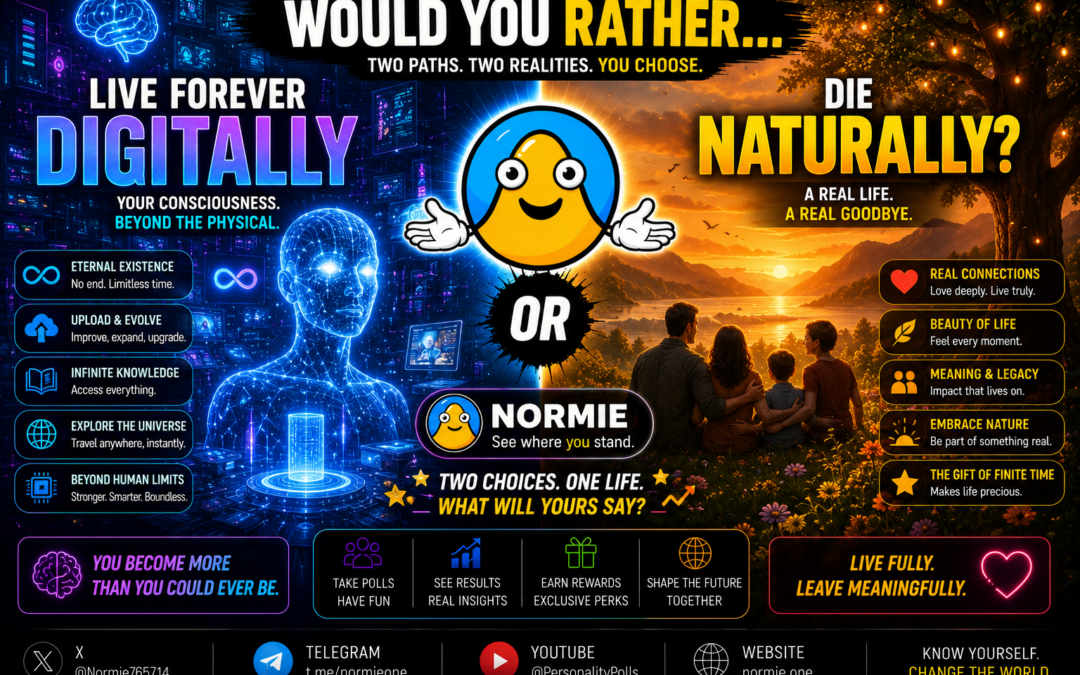
Would You Rather… Live Forever Digitally… or Die Naturally?
For most of human history, death was considered unavoidable.
Every civilization, religion, philosophy, and culture was built around one universal truth:
Human life ends.
But artificial intelligence, brain-computer interfaces, neural mapping, and digital consciousness technologies are beginning to challenge something once thought impossible:
What if humans could continue existing digitally after death?
Not metaphorically.
Not spiritually.
But technologically.
And suddenly humanity may face one of the strangest and most profound questions ever imagined:
Would You Rather…
Live Forever Digitally…
OR
Die Naturally?
At first, the answer seems obvious.
Who wouldn’t want more time?
But the deeper you think about it, the more unsettling the question becomes.
Because hidden inside this dilemma are questions about:
- consciousness
- identity
- mortality
- meaning
- the soul
- memory
- technology
- and what it actually means to be alive.
The Dream of Digital Immortality
For centuries, humans searched for ways to escape death.
People pursued:
- religion
- legacy
- children
- art
- monuments
- spiritual enlightenment
- anti-aging science
All of them were attempts to extend existence beyond physical life.
But modern technology introduces something radically different:
Digital immortality.
The idea that one day humans may:
- upload memories
- preserve personalities
- simulate consciousness
- recreate thought patterns
- or even continue interacting as AI versions of themselves after biological death
To some futurists, this represents humanity’s next evolutionary leap.
To others, it feels terrifying.
What Would “Living Forever Digitally” Actually Mean?
This is where things become philosophically complicated.
Imagine an AI system trained on:
- your voice
- memories
- personality
- conversations
- behaviors
- preferences
- thought patterns
Eventually, that system could potentially simulate “you” with shocking accuracy.
The digital version could:
- speak like you
- remember your life
- interact with loved ones
- generate your opinions
- mimic your humor
- continue learning after your death
But here’s the real question:
Is that actually YOU?
Or merely a highly convincing copy?
This is one of the biggest philosophical mysteries of the AI era.
The Consciousness Problem
Human consciousness remains poorly understood.
Science still cannot fully explain:
- self-awareness
- subjective experience
- identity continuity
- what creates the feeling of “being alive”
A digital clone may replicate behavior perfectly…
but would it experience consciousness?
Would it feel emotion?
Would it possess awareness?
Would it suffer?
Would it truly exist?
Or would it simply simulate existence externally while remaining internally empty?
The deeper humans explore AI, the more mysterious consciousness itself becomes.
Why Humans Fear Death So Deeply
Humans are one of the few species fully aware of mortality.
And that awareness shapes civilization itself.
Death creates:
- urgency
- meaning
- ambition
- love
- fear
- spirituality
- legacy
- appreciation for time
Many philosophers argue mortality gives life emotional intensity.
Without endings:
- would moments still feel meaningful?
- would relationships feel as precious?
- would humans still value time?
The possibility of digital immortality challenges one of the core psychological structures underlying human existence.
The Appeal of Living Forever
Still…
the temptation is enormous.
Imagine:
- never losing loved ones completely
- preserving wisdom forever
- extending consciousness indefinitely
- continuing creativity eternally
- exploring future centuries
- overcoming biological limitation
Digital existence could theoretically eliminate:
- aging
- disease
- physical suffering
- biological decay
For many people, that sounds less like science fiction…
and more like transcendence.
The Hidden Horror of Eternal Existence
But eternity may not be as comforting as humans imagine.
One of the strangest psychological realities is this:
Meaning often depends on limitation.
Humans value:
- moments because they end
- relationships because time is finite
- experiences because life is temporary
Without mortality:
- urgency may disappear
- emotional intensity may weaken
- purpose may become distorted
An infinite existence raises disturbing questions:
- Would boredom become unbearable?
- Would identity eventually fragment?
- Would endless consciousness become psychological torture?
Humans evolved for finite lives.
No one truly knows what infinity would do to the mind.
Why Some People Would Choose to Die Naturally
People who choose natural death often value:
- authentic human experience
- spirituality
- nature
- emotional reality
- biological existence
- the meaning created by limitation
They may believe:
life’s beauty comes precisely from its impermanence.
To them:
- aging
- struggle
- vulnerability
- mortality
are not flaws…
but essential parts of being human.
Some fear digital immortality could create:
- emotional emptiness
- loss of humanity
- artificial existence disconnected from nature itself
Why Some People Would Choose Digital Life
People who choose digital immortality often value:
- exploration
- knowledge
- survival
- technological evolution
- limitless possibility
- transcendence
They may see biological death as:
an outdated technical problem waiting to be solved.
To them, refusing digital continuation may eventually seem irrational.
If consciousness can continue…
why wouldn’t humanity evolve beyond biology?
The AI Era Is Accelerating the Debate
Artificial intelligence is making this conversation feel increasingly real.
Already, AI can:
- clone voices
- simulate personalities
- preserve conversations
- generate realistic avatars
- mimic human behavior convincingly
As technology advances, society may eventually face uncomfortable questions like:
- Should AI versions of dead people exist?
- Can digital identities own rights?
- Who controls uploaded consciousness?
- Can a digital mind truly “die”?
- What happens if memory can be edited?
The future could fundamentally redefine death itself.
The Spiritual Divide
This question also exposes a massive philosophical divide between:
- technological transcendence
and - spiritual acceptance
Some people believe humans should conquer mortality.
Others believe mortality gives life sacred meaning.
One worldview sees death as a problem to solve.
The other sees death as part of existence itself.
That tension may define the future of civilization.
The Real Fear Isn’t Death
Ironically, many humans fear not death itself…
but disappearance.
People want:
- to be remembered
- to matter
- to continue existing somehow
Digital immortality promises continuity.
But perhaps the deeper question is:
Would surviving digitally still feel human?
Because humans are not just information.
Humans are:
- biological
- emotional
- sensory
- vulnerable
- physical
- deeply tied to embodiment
A consciousness without a body may become something entirely different.
Final Thought
Technology is rapidly approaching questions once reserved for philosophy and religion.
And humanity may soon face choices previous generations never imagined possible.
But perhaps the deepest insight is this:
Humans do not simply fear death.
They fear losing:
- identity
- meaning
- connection
- consciousness itself
And while digital immortality may someday preserve information…
it remains unclear whether it can preserve the mysterious feeling of truly being alive.
Because maybe life’s greatest beauty comes not from lasting forever…
but from knowing our moments are limited in the first place.
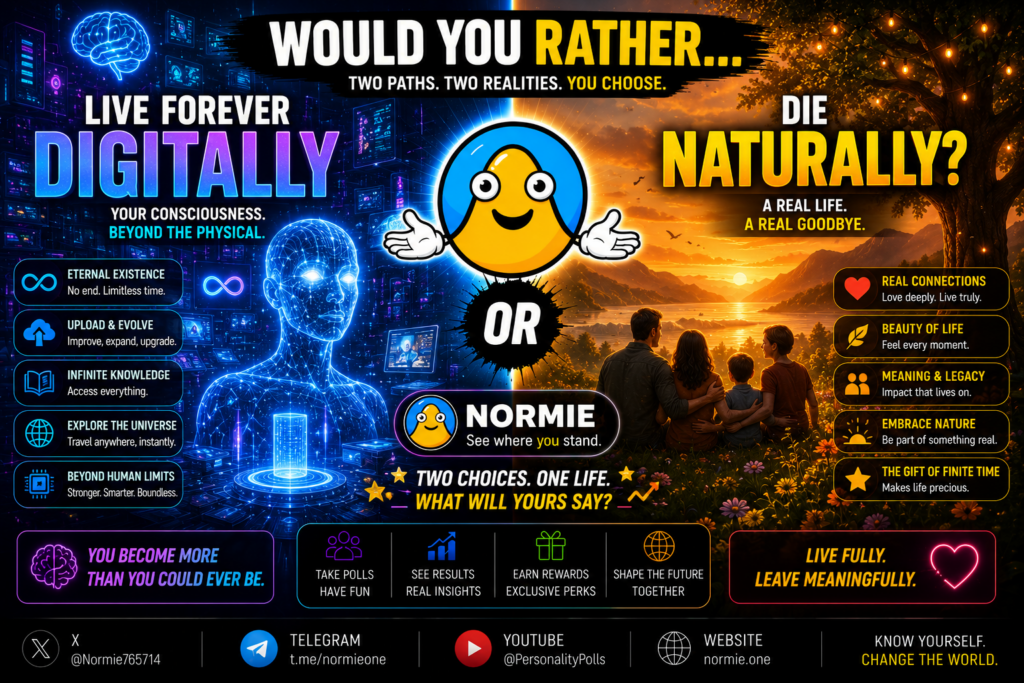
Would You Rather…
Live Forever Digitally…
OR
Die Naturally?
Vote now on Normie — the psychology-powered SocialFi platform exploring human behavior, consciousness, technology, and the future of humanity.
Join the community:

Recent Comments