
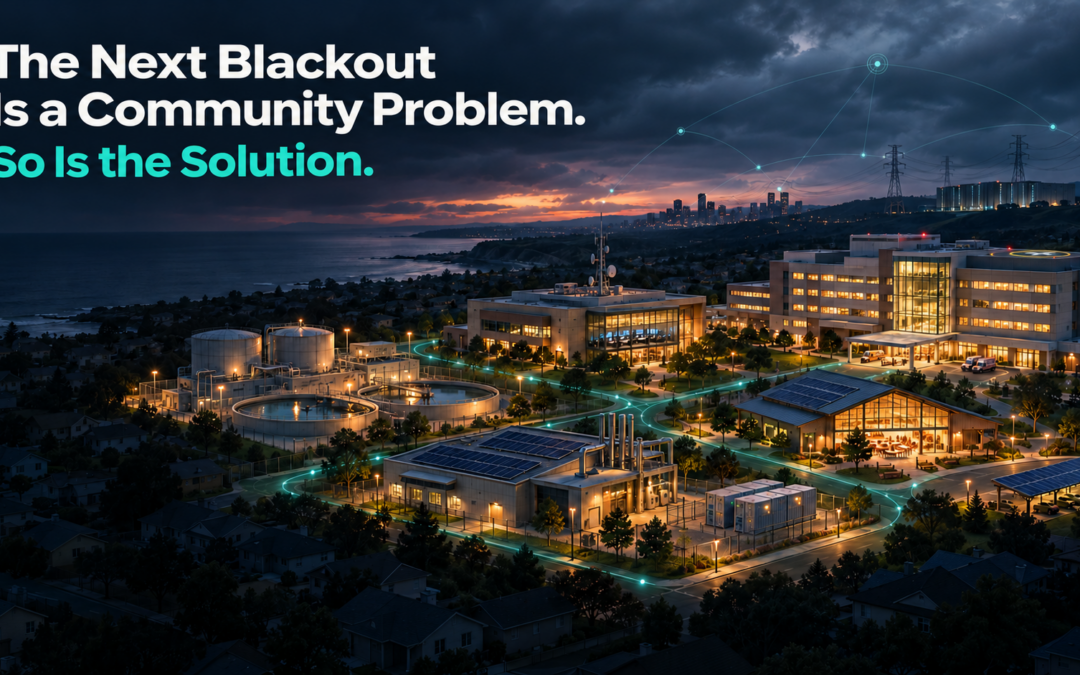
The Next Blackout Is a Community Problem. So Is the Solution.
AI is increasing electricity demand and changing cyber threats. Microreactors could help—but the strongest defense starts with a more practical question: what must keep running when the grid goes down?
The first thing you lose in a blackout is electricity.
What you lose next depends on how well your community has prepared.
Traffic signals stop. Elevators stall. Refrigeration becomes a countdown. Cellular service may weaken as backup batteries drain. Water and wastewater systems depend on the condition of their generators, fuel supplies and electrical controls.
For an older resident in a hot apartment, the emergency may begin long before food spoils. For a water utility, electricity can mean the difference between maintaining service and issuing emergency restrictions.
America’s grid supports an extraordinary standard of living. But its importance creates a difficult reality: when electricity fails, many systems that appear separate begin failing together.
The answer deserves more thought than either “trust the utility” or “put a nuclear reactor in every town.”
Communities need to understand their dependencies, protect essential services and build the ability to operate through disruption. AI, batteries, solar, generators, stronger transmission and emerging nuclear technologies can all contribute. Their value depends on how they work together.
The warning is already in the outage statistics
U.S. electricity customers experienced an average of approximately 11 hours of interruptions in 2024, nearly twice the annual average over the preceding decade. Major events, including Hurricanes Beryl, Helene and Milton, accounted for about 80% of the time without electricity, according to the U.S. Energy Information Administration. U.S. Energy Information Administration (EIA)
That national average conceals the experience that matters locally. Some customers lost power briefly; others faced much longer disruptions. A household without electricity for several days gains little comfort from a favorable national reliability percentage.
It also points to an important distinction: preventing everyday outages and surviving exceptional disasters are different engineering problems.
A system can perform well during normal conditions while remaining vulnerable to flooding, extreme heat, widespread storm damage or the loss of a crucial substation.
Reliability asks how often the power fails. Resilience asks what happens after it does.
Why the military is investing in independent power
The military’s interest in local generation reflects a basic operational requirement: essential missions must continue even when surrounding infrastructure is damaged.
In August 2026, the Army announced that its Janus Program had selected five nuclear vendors and five initial installations. The program includes up to $2.2 billion in milestone-based government funding, alongside private investment, with an expectation of more than 20 microreactors across military installations. The target for the first operating reactor is September 2028; the prototypes will be contractor-owned and operated. www.army.mil
The broader FORTRESS America initiative also emphasizes independence from vulnerable civilian infrastructure. Reporting describes a goal of sustaining essential installation operations for at least 90 days without outside support, although The War Zone noted uncertainty about explicit Pentagon confirmation of that particular duration. www.twz.com
These initiatives are evidence of contingency planning. They do not establish that a nationwide blackout is imminent.
Their civilian relevance is more practical: hospitals, water systems, emergency communications and shelters also perform missions that cannot simply pause.
Communities should identify those missions with the same seriousness.
AI makes the electricity challenge larger—and more local
AI runs on physical infrastructure: chips, servers, cooling equipment, substations and power plants.
Lawrence Berkeley National Laboratory’s 2025 Update, published in June 2026, estimates that data centers could consume 11.8% of U.S. electricity by 2030, with scenarios ranging from 9.5% to 15.3%. These figures cover all data centers, rather than AI alone, and represent modeled possibilities rather than guaranteed outcomes. Building & Industrial Energy Systems Division
Globally, the International Energy Agency’s 2026 outlook projects data-center electricity consumption increasing from approximately 485 terawatt-hours in 2025 to 950 terawatt-hours in 2030. AI-focused facilities are expected to grow faster than the overall sector. IEA
National percentages tell only part of the story. Electricity constraints occur at specific locations.
A region may have sufficient annual energy production while lacking the transmission capacity, transformers or generating reserves needed to serve a concentrated cluster of new facilities during peak demand.
That makes data-center development a community planning issue. Before approving a large project, officials should ask:
- Who pays for the required grid upgrades?
- What happens if projected demand never materializes?
- Can some computing workloads reduce consumption during emergencies?
- Does the facility’s backup power benefit surrounding essential services?
- How will its electricity and cooling needs interact with local constraints?
A well-designed agreement can bring investment while assigning costs and responsibilities clearly. A weak agreement can leave residents exposed to expenses and risks they did not understand.
Cyber threats are real without a doomsday narrative
The strongest evidence of infrastructure cyber risk comes from documented intrusions.
In a February 2024 joint advisory, CISA, the NSA and the FBI assessed that Chinese state-sponsored actors associated with Volt Typhoon were positioning themselves inside U.S. critical infrastructure networks to enable disruption during a major crisis or conflict.
The advisory identified compromises affecting communications, energy, transportation, and water and wastewater organizations. Investigators observed indications that attackers had maintained access in some victim environments for at least five years. cisa.gov
That is a serious warning. It also requires careful interpretation.
Access to an organization’s business network does not automatically confer control over its electrical equipment. Physical consequences depend on network architecture, permissions, protective systems and the attacker’s technical capabilities.
The danger is that poorly protected connections can allow a manageable intrusion to become a much larger operational problem.
A realistic defense therefore includes routine work that rarely makes headlines: replacing unsupported equipment, restricting remote access, separating business and operational networks, monitoring unusual activity and rehearsing recovery.
AI can increase the pressure on defenders
AI can help attackers research targets, improve fraudulent messages, analyze software and automate portions of an intrusion.
The UK’s National Cyber Security Centre assesses that AI will make elements of cyber operations more efficient and effective through 2027. It also judges that fully automated, end-to-end advanced attacks are unlikely within that timeframe; skilled humans remain important. National Cyber Security Centre
The practical concern is scale. A utility already struggling to update equipment and investigate alerts may face more convincing deception and faster exploitation of known weaknesses.
Adding AI to utility operations can introduce further dependencies. An assistant connected to maintenance records, vendor communications or operational tools needs carefully limited permissions. Its recommendations should never bypass engineering safeguards.
An AI system should have only the authority its failures can safely tolerate.
For a document-search assistant, an error may produce a bad answer. For a system influencing electrical switching, the consequences can be physical.
Three scenarios that reveal the real problem
The following are illustrative planning scenarios, not predictions. Each tests a different weakness.
Scenario one: A coastal city loses power for 72 hours
A hurricane damages distribution lines and floods equipment. Some neighborhoods recover quickly. Others remain disconnected.
The city has emergency generators, but one transfer switch fails. Fuel deliveries are delayed. A cooling center has electricity, yet residents cannot reliably reach it or learn that it is open.
The lesson is that owning backup equipment does not establish operational readiness.
A credible plan needs tested generators, protected electrical equipment, realistic fuel arrangements, working communications, transportation support and clearly assigned responsibilities.
It should also identify which buildings can serve residents safely when surrounding areas remain dark.
Scenario two: A cyber incident creates uncertainty
Operators detect suspicious activity and restrict remote access while investigating. Some equipment remains functional, but staff cannot immediately trust every screen, account or instruction.
Restoring normal operations requires more than rebooting computers. Personnel need to establish which systems are trustworthy, confirm equipment status and coordinate safe recovery.
This scenario tests whether the organization can operate with reduced digital visibility.
Useful preparations include verified recovery copies, independent communications, documented procedures and trained personnel who can perform essential tasks when ordinary software is unavailable.
Scenario three: Heat, demand growth and equipment failure coincide
A prolonged heat wave drives air-conditioning demand upward. A major component fails while regional electricity supplies are already strained.
Hospitals, homes and data centers all need power at the same time.
This scenario tests flexibility: can buildings reduce demand, batteries discharge, participating facilities curtail selected loads and operators maintain safe reserves?
The most valuable resource may be electricity that can be conserved immediately, especially when doing so protects critical services.
Microgrids turn local resources into a working system
A microgrid coordinates local generation, storage and electricity demand. When designed for islanding, it can disconnect safely from the wider grid and continue supplying its designated customers.
The controls matter as much as the equipment.
Solar panels on a roof do not automatically provide outage protection. Many conventional grid-connected installations shut down when the grid fails. Backup operation requires suitable inverters, electrical isolation, controls and an appropriate energy source or storage arrangement. www.energy.gov
Microgrids also require choices about scope. Backing up several essential facilities is a smaller undertaking than supplying every home and business continuously. DOE explicitly distinguishes these designs and their capacity requirements. www.energy.gov
A community can begin with a water facility, emergency operations center and public shelter. Expanding from demonstrated performance is more credible than promising immediate energy independence.
There are working examples. During a 2019 California public-safety power shutoff, Blue Lake Rancheria served an estimated 10,000 people in less than 30 hours, supported by its microgrids and emergency planning, according to DOE. Department of Energy
Its achievement illustrates a useful goal: keep a functioning place available when the surrounding region is struggling.
Understand the difference between power and endurance
Energy proposals often sound impressive because their numbers lack context.
Megawatts measure the rate of power delivery. Megawatt-hours measure an amount of energy.
Consider an illustrative community hub requiring a steady 1 megawatt:
| Outage duration | Energy required |
|---|---|
| 4 hours | 4 megawatt-hours |
| 24 hours | 24 megawatt-hours |
| 72 hours | 72 megawatt-hours |
| 7 days | 168 megawatt-hours |
These simplified figures exclude losses, operating reserves and changes in demand.
A battery with 4 megawatt-hours of usable energy can support that load for approximately four hours without replenishment. Its ability to deliver 1 megawatt must also be confirmed.
Solar can extend endurance, but production changes with weather and time of day. Generators can run longer, but require dependable fuel and maintenance. A microreactor could provide sustained generation, but would still need provisions for outages and supporting equipment.
The appropriate combination follows from the required service and outage duration.
Reducing the hub’s load from 1 megawatt to 0.6 megawatts would extend the same stored energy from four hours to about 6.7 hours. Efficiency can therefore buy valuable operating time.
Where nuclear microreactors could fit
Microreactors could offer compact, sustained electricity generation for installations where fuel logistics or prolonged outages are especially costly.
DOE describes Westinghouse’s eVinci design as targeting 5 megawatts of electricity and eight or more years between refueling. Radiant’s Kaleidos design targets 1.2 megawatts and five years between refueling. These are design specifications, rather than an established fleet’s operating record. www.energy.gov
Potential applications include remote communities, industrial facilities and military installations with a high need for dependable local power.
Municipal adoption still requires answers about delivered cost, licensing, staffing, security, fuel availability, maintenance and decommissioning. The NRC is developing a proposed Part 57 framework intended to accommodate microreactors’ characteristics and deployment models. www.nrc.gov
A reactor also does not eliminate the need for a reliable local electrical network. Electricity cannot reach a shelter through a flooded switchboard or a broken feeder.
Communities can prepare for future nuclear options while improving existing infrastructure now.
Why “free electricity” is the wrong sales pitch
A publicly funded generator still has costs. Residents pay through taxes, rates, debt service or some combination.
Consider a hypothetical 10-megawatt electrical reactor, costing $150 million, operating at a 95% capacity factor, with $10 million in annual operating expenses.
It would generate approximately 83.2 million kilowatt-hours annually.
Spreading capital costs evenly over 40 years produces a simplified cost of approximately 16.5 cents per kilowatt-hour. Annualizing that same investment over 40 years at an illustrative 5% cost of capital raises the figure to approximately 22.5 cents.
Neither calculation validates the assumed reactor price or operating budget. Both exclude any costs missing from those assumptions.
The comparison must also account for delivery. Household retail electricity prices include services beyond generation. A reactor’s output cannot automatically be valued at the full retail rate while the continuing costs of distribution are ignored.
The useful question is:
What is the full cost of supplying dependable electricity, and what additional value comes from keeping essential services available during an emergency?
That second benefit matters. A resilience project may be worthwhile even when its ordinary electricity costs are higher, provided its emergency value justifies the difference.
Decentralization needs redundancy and accountability
Distributing generation can reduce dependence on distant equipment. It can also create more devices to secure, maintain and coordinate.
Twenty local systems relying on one vulnerable remote-management platform may share a major point of failure. A town dependent on a single reactor may have concentrated its risk locally. A neighborhood battery may perform poorly if nobody owns the maintenance responsibility.
A sound design therefore combines:
- Multiple ways to supply essential loads.
- The ability to isolate damaged or compromised sections.
- Local control when outside communications fail.
- Trained staff and funded maintenance.
- Clear ownership of decisions, costs and emergency duties.
Regional interconnection remains valuable because communities can share resources. Local independence becomes especially valuable when those connections fail.
The aim is to preserve both capabilities.
AI can help—when its benefits are demonstrated
AI can support demand forecasting, equipment inspection, maintenance planning and the coordination of distributed resources.
DOE and Sandia National Laboratories have also developed an AI-assisted protective-relaying approach that DOE says can locate and isolate certain faults approximately 100 times faster than traditional protection equipment. Its August 2025 description identified utility demonstrations as the next step, so the reported capability should not be mistaken for universal field performance. Department of Energy
That distinction should guide AI procurement.
Utilities should ask whether a tool improves a measurable outcome: fewer failures, earlier detection, faster restoration or lower operating costs. They should test performance under unusual conditions, establish safe operating limits and preserve a workable fallback.
A control system that requires uninterrupted cloud access creates a dependency that must be included in the outage plan.
A practical community agenda
A useful resilience program begins with services and ends with demonstrated capability.
| Priority | What communities should establish |
|---|---|
| Identify essential services | Which water, health, shelter, communications and emergency functions must continue? |
| Measure actual loads | What power, startup capacity and energy does each service require? |
| Test present arrangements | Do generators, batteries, transfer switches and communications work under realistic conditions? |
| Protect operational systems | Who can access controls, and can essential operations continue after a cyber incident? |
| Build local endurance | Which combination of efficiency, storage and generation meets the required outage duration? |
| Assign responsibility | Who funds maintenance, authorizes emergency decisions and verifies readiness? |
| Exercise recovery | Can the system disconnect, operate independently and reconnect safely? |
Plans should include residents who cannot easily compensate for infrastructure failures: older adults, people using medical equipment, households without transportation and renters without access to private backup power.
Public reporting should focus on usable outcomes. How long can the water system operate? Which shelters have tested backup cooling? When did the community last demonstrate islanded operation?
Those answers are more meaningful than the number of panels installed or the capacity announced in a press release.
A city cannot promise that every light will remain on through every disaster.
It can make a credible, tested commitment that drinking water, emergency communications and places of refuge will remain available—and build its energy system around keeping that commitment.

Recent Comments