
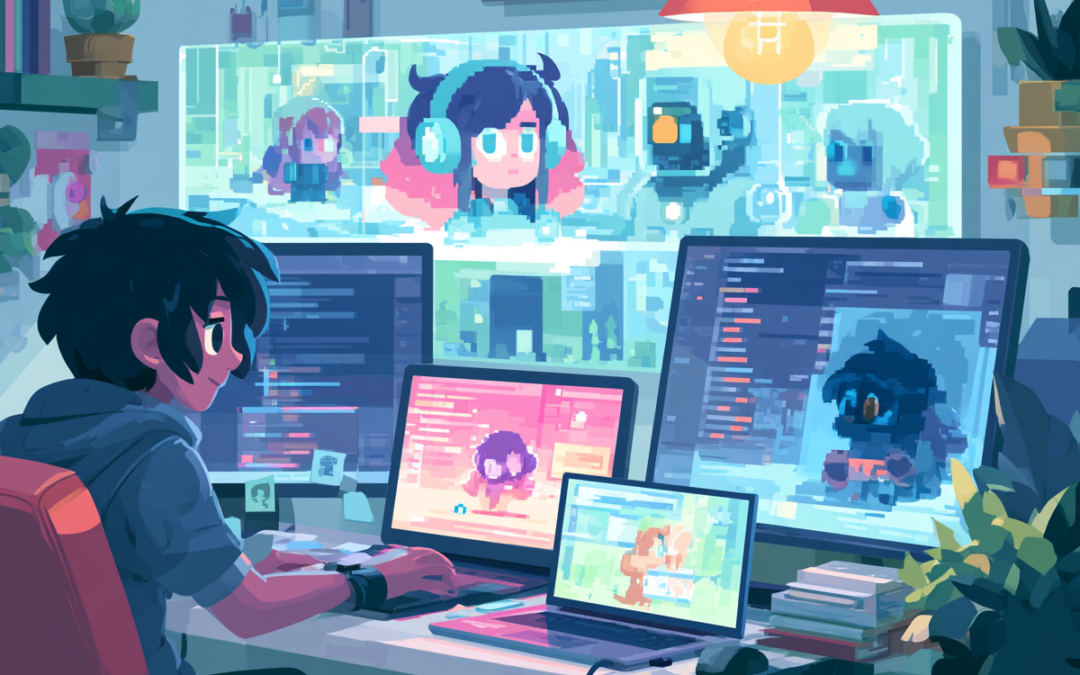
The One-Person Game Studio: How AI Is Turning Ideas Into Playable Worlds
For decades, creating a successful video game required a rare combination of coding ability, artistic talent, technical infrastructure, money, and time.
A solo creator might have a brilliant idea but no programming skills. A developer could build the mechanics but struggle with art, animation, sound, or marketing. Even a simple game could take years to complete.
AI is beginning to dismantle those barriers.
Tools such as Claude Code can now help ordinary creators transform written instructions into working game mechanics. Image-generation platforms can produce concept art, backgrounds, characters, menus, logos, and promotional materials. Affordable asset marketplaces offer thousands of ready-made sprites, animations, sound effects, and environments.
The result is the emergence of something surprisingly powerful:
The one-person AI game studio.
A creator no longer needs to personally write every line of code or draw every sprite. Instead, they can act as the game’s director, describing the experience, testing prototypes, diagnosing problems, choosing assets, and guiding AI through hundreds of small improvements.
That does not make game development effortless. But it makes it accessible in a way that would have seemed impossible only a few years ago.
From Player to Creator
Games such as Vampire Survivors demonstrated that a relatively simple concept can become a global phenomenon.
The formula appears almost minimal:
- Move a character around the screen.
- Attack enemies automatically.
- Collect experience.
- Level up.
- Choose upgrades.
- Survive increasingly difficult waves.
- Become dramatically more powerful.
Yet beneath that simplicity is a remarkably effective psychological loop. Every defeated enemy releases a reward. Every level offers a decision. Every upgrade changes the player’s capabilities. Every new wave creates greater pressure.
The player is constantly moving between tension and reward.
This makes the “survivors-like” genre especially attractive to new AI-assisted developers. Its core mechanics are understandable, its visual requirements can be manageable, and a basic version can be prototyped relatively quickly.
A creator might replace vampires and monsters with a chicken defending a farm against wolves, bears, farmers, and an enormous tractor boss. Another might build a tennis player surviving waves of robotic opponents. Someone else could create a crypto-themed world in which a trader battles scams, market crashes, liquidations, and hostile trading bots.
The underlying structure may be familiar, but the setting, personality, progression, humor, and community can make the experience original.
That is where the creator’s imagination becomes more important than traditional coding ability.
The Prompt Is the New Design Document
One of the biggest mistakes beginners make is asking AI to “create an entire game” in a single prompt.
AI may produce something playable, but it will usually be generic, inconsistent, buggy, or shallow. A polished game is too complicated to define properly with one vague instruction.
The better approach begins with a game-design brief.
Before asking AI to write code, the creator should describe:
- The central concept
- The player’s objective
- The core gameplay loop
- Movement and controls
- Enemy behavior
- Combat mechanics
- Experience and leveling
- Upgrade choices
- Difficulty progression
- Art direction
- Sound and music
- Saving and progression
- Victory and failure conditions
This initial prompt gives the AI a mental model of the complete project.
The creator can then divide development into manageable stages:
- Build responsive player movement.
- Add enemy spawning and pursuit.
- Add automatic attacks and collision detection.
- Introduce health, damage, and death.
- Create experience drops and leveling.
- Add upgrade selections.
- Build increasingly difficult waves.
- Introduce currency and permanent progression.
- Create menus and save systems.
- Add art, animation, audio, and visual effects.
This staged approach makes errors easier to identify. If player movement works before combat is added, the creator knows that a later problem probably came from the combat system rather than the original movement code.
AI performs much better when it is given one clearly defined problem at a time.
The Prototype Is Not the Product
AI can produce a playable prototype surprisingly quickly.
A colored shape can become the player. Other shapes can become enemies. The player moves, enemies follow, attacks fire, collisions register, and defeated enemies disappear.
That moment feels extraordinary, especially to someone who has never written code.
But it is also dangerous.
A functional prototype can create the illusion that the game is nearly finished. In reality, it may represent only the beginning of development.
A commercial game still needs:
- Responsive controls
- Balanced difficulty
- Interesting enemies
- Satisfying progression
- Clear user interfaces
- Reliable saving
- Good performance
- Sound design
- Visual feedback
- Accessibility options
- Controller support
- Extensive testing
- Store assets and marketing
The difference between a ten-minute prototype and a successful Steam release is not simply more code. It is hundreds of thoughtful decisions.
Is the player attacking too quickly?
Do enemies have too much health?
Are upgrades meaningfully different?
Does the game become repetitive?
Can players understand what damaged them?
Does every weapon feel powerful?
Is there a reason to begin another run?
AI can help implement solutions, but the human creator must recognize which problems matter.
Game Feel Is the Invisible Advantage
Players may forgive simple graphics. They rarely forgive a game that feels unpleasant to control.
Movement should be immediate and predictable. Attacks need visual and audible impact. Enemies should react when hit. Experience should flow toward the player in a satisfying way. Level-up moments should briefly interrupt the action and offer meaningful choices.
These details collectively create “game feel.”
A projectile can technically damage an enemy without feeling satisfying. Add a flash, sound, knockback effect, damage number, tiny camera shake, and particle burst, and the same action suddenly feels powerful.
This is why early development should prioritize responsiveness before visual polish.
If movement and combat are enjoyable using basic placeholder shapes, artwork can make the experience better. If the underlying mechanics feel dull, beautiful graphics will only decorate the problem.
AI Art Meets Affordable Asset Libraries
Coding is only one part of creating a game. A complete project also requires characters, monsters, environments, icons, buttons, menus, logos, animations, and promotional images.
Creators now have several options.
Asset marketplaces such as itch.io offer enormous collections of free and inexpensive game assets. A developer can purchase a coherent sprite pack rather than creating every character from scratch.
AI image tools can help generate:
- Menu backgrounds
- Game logos
- Character concepts
- Enemy concepts
- Environment references
- Achievement icons
- Steam capsule art
- Marketing visuals
Existing sprite sheets can then be integrated into the game with AI coding assistance. The creator can explain which frames represent upward, downward, left, and right movement, and the coding agent can help construct the animation system.
However, licensing still matters. A commercially released game must have permission to use every asset, font, sound, image, and animation it contains. “Available online” does not mean “free for commercial use.”
AI does not remove that responsibility.
Turning a Menu Into a World
A menu is often the player’s first emotional encounter with a game.
A plain screen with a basic title and a Play button may be functional, but it does little to establish personality. A carefully designed menu can immediately communicate genre, atmosphere, humor, and quality.
An AI-generated background could depict a knight overlooking an approaching horde. Subtle animation could move the character’s cape, clouds, fog, firelight, or grass. A custom logo could float above buttons designed in the same visual style.
The menu could eventually include:
- Continue
- New Game
- Character Selection
- Armory
- Upgrades
- Achievements
- Leaderboards
- Settings
- Credits
This is more than decoration. It creates anticipation.
When the presentation, mechanics, music, and identity reinforce one another, the game begins to feel like a coherent world rather than a collection of AI-generated components.
The Real Business Opportunity
Stories about solo-developed games earning millions are understandably irresistible. They suggest that anyone with an idea and an AI subscription could create the next breakout hit.
Technically, that possibility exists.
Statistically, it remains extremely unlikely.
Steam is crowded. Players have endless choices. A competent game can disappear without reviews, community support, creator coverage, or a compelling hook. AI will increase the number of games released, making attention even harder to earn.
The opportunity is real, but it is not simply “use AI and become rich.”
The deeper opportunity is that experimentation has become cheaper.
A creator can test several ideas before committing years to one of them. They can release a small demo, observe player behavior, gather feedback, and decide whether the concept deserves further investment.
This changes the economics of creativity.
Failure becomes less expensive. Prototyping becomes faster. Small niches become more viable. Creators can build games for communities that traditional studios would consider too specialized.
A tennis coach could make a tactical tennis game. A musician could build an interactive rhythm world. A crypto community could create a game around its characters and culture. An educator could turn a course into an adventure.
AI makes narrow, personal, community-driven games more practical.
Originality Will Become More Valuable
As AI development becomes easier, digital marketplaces will be flooded with imitations.
There will be countless survival games, platformers, card battlers, puzzle games, and farming simulations created from similar prompts. Many will use familiar mechanics and nearly identical visual styles.
Therefore, the competitive advantage will shift away from the ability to produce code.
The scarce resources will be:
- Taste
- Originality
- Storytelling
- Community
- Humor
- Emotional resonance
- Quality control
- Distribution
- Consistent creative direction
AI can generate ten logos, but it cannot automatically determine which one best expresses the game’s identity. It can add twenty upgrades, but it cannot guarantee that the choices create an enjoyable strategic system.
The creator remains responsible for taste.
That may become the defining skill of the AI era: knowing what to keep, what to reject, what to improve, and what the experience is ultimately trying to say.
A Practical Development Path
An aspiring AI game creator does not need to begin with a massive dream project.
A more realistic path would be:
- Write a one-page game concept.
- Define one compelling gameplay loop.
- Build movement and one enemy.
- Add a basic attack.
- Make the first five minutes enjoyable.
- Introduce progression and meaningful upgrades.
- Replace placeholders with licensed assets.
- Add sound, feedback, menus, and saving.
- Let real players test it.
- Improve the game based on observed behavior.
- Create a polished demo.
- Build an audience before launch.
Start small enough to finish.
A completed 20-minute game teaches more than an unfinished 100-hour epic. Each finished project improves the creator’s prompting, debugging, design judgment, production discipline, and understanding of players.
The Birth of the AI Creative Director
The most important shift is not that AI can write code.
It is that people who previously could not build software can now direct its creation.
The solo developer becomes a creative director who moves between roles:
- Game designer
- Prompt writer
- Product manager
- Art director
- Playtester
- Editor
- Marketer
- Community builder
They do not need to master every discipline, but they must learn enough to guide each one intelligently.
AI can propose solutions. It can implement mechanics. It can diagnose bugs and reorganize code. It can help produce artwork and marketing materials.
But the human still supplies the intention.
What should the player feel?
Why should they care?
What makes this world memorable?
Why would someone recommend the game to a friend?
Those are not merely coding questions. They are creative questions.
Final Thought
AI is not eliminating the craft of game development. It is moving the craft to a different level.
The barrier is no longer simply whether someone can write code. The new challenge is whether they can develop a strong idea, communicate it clearly, evaluate what AI produces, and patiently turn a rough prototype into an experience worth playing.
Millions of people can now attempt to build games.
Far fewer will finish them.
Fewer still will polish them, develop a distinctive identity, build a community, and successfully bring them to market.
That is where the real opportunity lives.
The next breakthrough independent game may not come from a major studio or an experienced programmer. It could come from a teacher, artist, coach, creator, or entrepreneur who understands a particular community and finally has the tools to turn an idea into a playable world.
The age of the one-person AI game studio has begun.
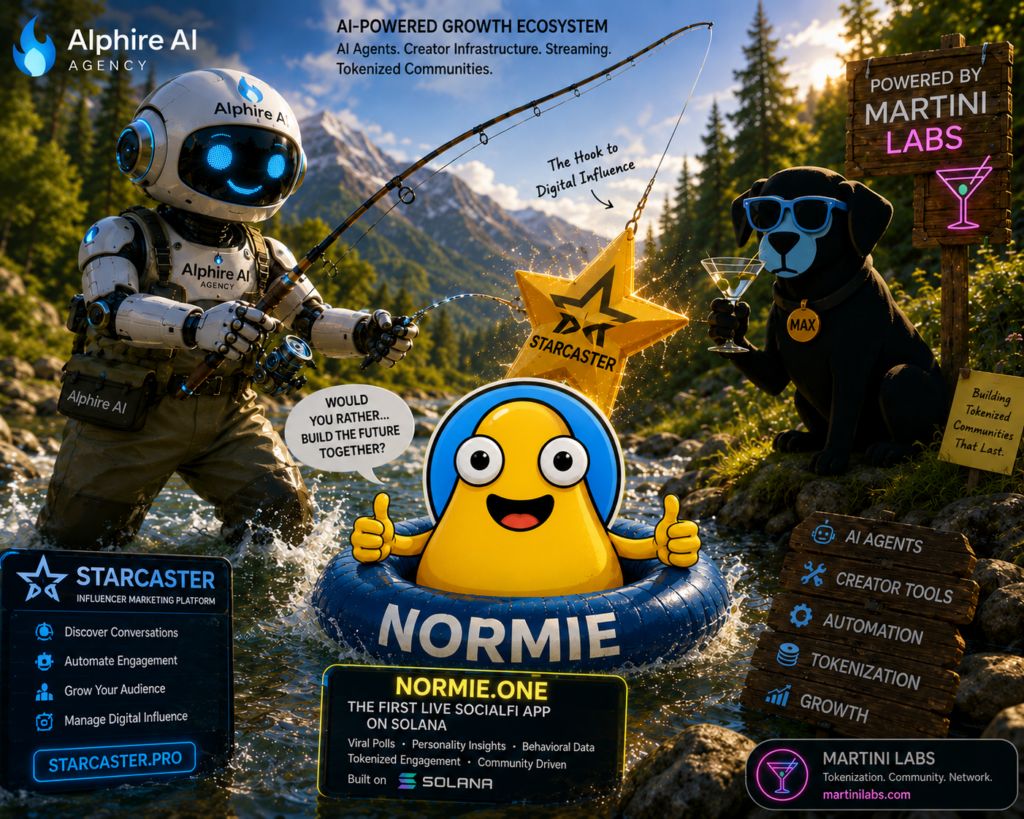
From Attention to Ownership
Starcaster Pro by Alphire AI is the growth engine for the next generation of brands, creators, and tokenized communities.
Starcaster Pro uses AI agents to discover relevant conversations, identify creators, automate personalized engagement, manage campaigns, publish content, and measure growth. But attracting attention is only the beginning.
Normie transforms that attention into participation through viral “Would You Rather?” polls, personality insights, behavioral data, community interaction, and SocialFi rewards.
Martini Labs completes the ecosystem by helping brands tokenize loyalty, reward valuable contributions, raise support, and give communities a meaningful stake in what they help build.
Together, they create a powerful growth flywheel:
Starcaster Pro attracts the audience.
Normie activates the community.
Martini Labs turns engagement into ownership.
Alphire AI automates and connects it all.
This is more than influencer marketing. It is an AI-powered system for turning conversations into communities, communities into ecosystems, and engagement into lasting value.
Discover. Engage. Reward. Own. Grow.

Recent Comments